Walk into any conversation about competitive gaming and reaction time will come up within the first few minutes. It's treated as the fundamental divide between skilled and unskilled players — the thing you either have or you don't. But this framing, while intuitive, misses most of what actually happens between stimulus and action in a competitive game.
Reaction time is real. It matters. But what it measures, and how it interacts with the other cognitive and physical processes in gaming, is considerably more complicated than the popular version suggests. This article looks at what reaction time actually is, how it shows up in games, and what the evidence says about whether it can be meaningfully improved.
What Reaction Time Actually Measures
In controlled laboratory settings, reaction time is typically measured as the interval between a stimulus — a sound, a light, a visual cue — and the moment a subject initiates a response. The most commonly cited figures from these studies place average human visual reaction time somewhere between 200 and 250 milliseconds for simple, expected stimuli.
The important phrase there is "simple, expected stimuli." In a reaction time test where you're told to click a button the moment a light turns green, the task is straightforward: there's one stimulus, one response, and no decision required. The measurement captures something real about your nervous system's basic speed. But this setup shares very little with what happens in a competitive game.
"Reaction time tests measure one narrow slice of cognitive performance. Gaming draws on several different systems simultaneously — perception, anticipation, motor execution, and decision-making — and the relationship between them is not simple."
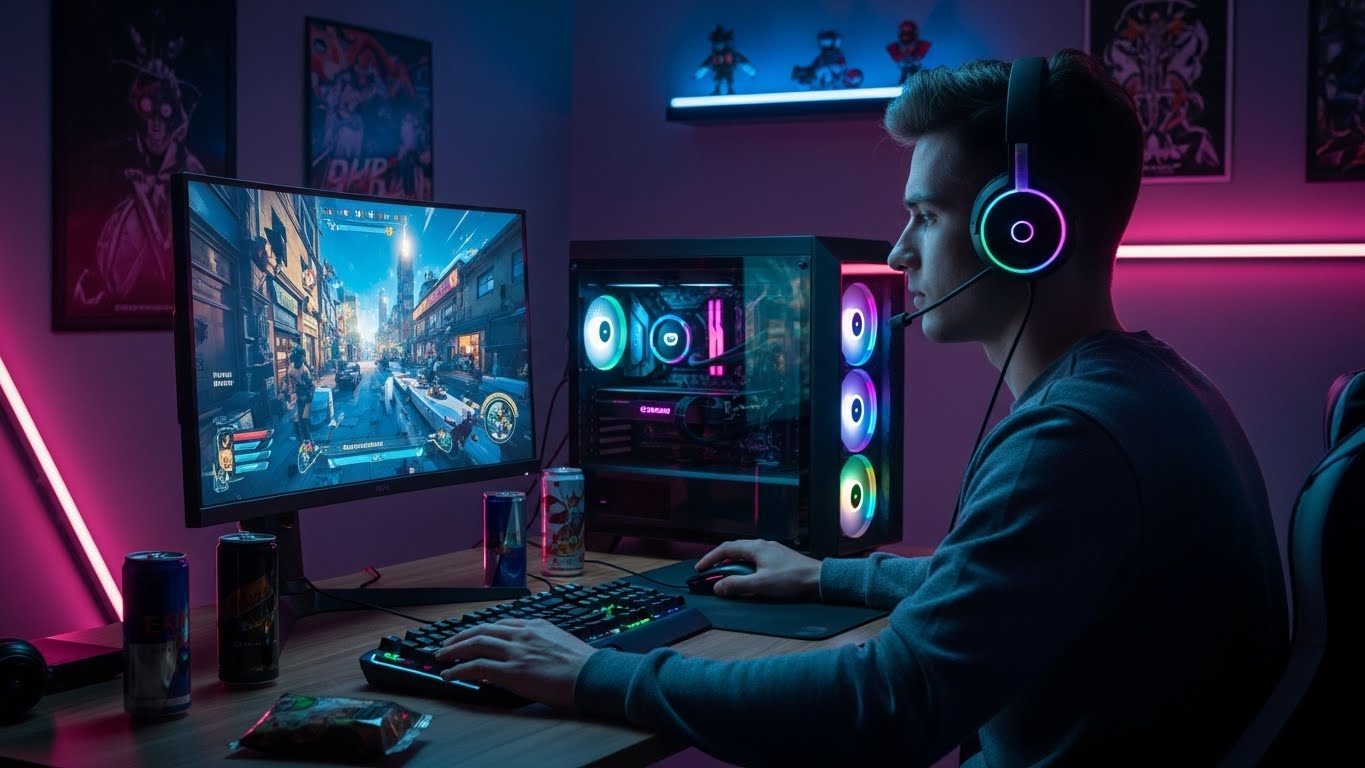
In a first-person shooter, for instance, you're not waiting for a single expected cue. You're maintaining situational awareness, predicting enemy movement based on prior patterns, managing your own character's position, and processing audio cues from multiple directions — all before any identifiable stimulus even occurs. By the time an opponent enters your field of view, experienced players have already begun the process of aiming.
Simple vs. Choice Reaction Time
Psychologists have long distinguished between simple reaction time — one stimulus, one response — and choice reaction time, which involves selecting from multiple possible responses. Unsurprisingly, choice reaction time is slower, and by a more significant margin than most people expect.
This distinction is central to gaming. Almost every meaningful in-game reaction involves a choice. When an opponent appears, you need to assess distance, direction, cover availability, and ammunition state before you fire. The choice process adds latency on top of whatever raw neural speed you possess. Skilled players don't primarily overcome this through faster raw reaction times; they reduce the complexity of the choice itself.
This reduction happens through a process called anticipation. An experienced player watching an opponent move toward a door already knows, with reasonable probability, where that opponent will be a moment later. When the opponent appears, the player isn't reacting to a surprise — they're confirming a prediction. The decision has already been partially made. This is why top-level play can look superhuman from the outside: it isn't that these players have faster nervous systems, it's that they have more efficient prediction architectures built from accumulated experience.
The Role of Motor Memory
Alongside reaction and decision processing, there's the physical execution of the response: moving the mouse to the target and clicking. This sounds trivial but isn't. Motor memory — the stored patterns of physical movement — plays a substantial role in what looks like reactive performance.
When a player has performed a flick shot to a target at a given distance and speed many thousands of times, the execution of that movement becomes increasingly automatic. The involvement of conscious cognition decreases, and the movement can be initiated and completed more quickly. This is the neurological basis for the common observation that aiming "feels automatic" at higher levels of play — it literally is, in the sense that it's been offloaded from deliberate processing to procedural memory.
Practice, in this context, isn't just building speed. It's building the library of automatic movements that can be triggered efficiently. The implication is that improving your in-game performance through training is not primarily about training your raw nervous system speed — it's about expanding the range of situations you can handle without full deliberate processing.
Age and Reaction Time
Raw reaction time does change with age. Laboratory studies generally find that simple reaction time peaks in early adulthood — typically the mid-twenties — and declines gradually thereafter. The decline is modest through most of adulthood, becoming more pronounced in the sixties and beyond.
Within competitive gaming contexts, this data is sometimes used to imply that aging significantly impairs performance. The picture is more nuanced. First, the differences in raw reaction time between players in their twenties and those in their thirties are typically on the order of single-digit milliseconds — a difference that matters far less than prediction quality, decision-making speed, and mechanical habit. Second, experience-based advantages — the anticipation and motor memory discussed above — tend to accumulate with age and can substantially offset raw speed losses.
The correlation between raw reaction time and competitive ranking in actual games is weaker than commonly assumed. Studies analyzing esports players have found that experienced players at all ages outperform reaction time expectations based on their age group, suggesting that the cognitive aspects of gaming performance are at least as important as the neurological ones.
Hardware and Latency
The discussion of reaction time in gaming cannot be separated from the hardware context. Every system between your intention and the on-screen result introduces latency: input processing in the keyboard or mouse, USB polling intervals, CPU and GPU processing, and monitor display lag all add to the delay between what you do and what you see.
Modern high-end gaming peripherals and displays have reduced these delays substantially compared to equipment from ten years ago. A gaming mouse with a 1000Hz polling rate reports its position to the system every millisecond. A 240Hz monitor refreshes every 4.17 milliseconds. In aggregate, a well-configured gaming setup might have a total system latency — from input to displayed frame — of under 20 milliseconds.
This means that in a well-optimized setup, hardware latency accounts for a relatively small portion of the total reaction loop. The bottleneck is primarily cognitive. However, the difference between a 144Hz monitor and a 60Hz monitor (about 10ms versus 16ms refresh cycle) is measurable and, for high-level competitive play, meaningful. These hardware variables are real; they're simply not as large as they're sometimes marketed to be.
Can Reaction Time Be Trained?
The honest answer is: it depends on what you mean by reaction time. Raw neural signal speed — the base speed of your nervous system — is largely biologically determined and changes only modestly with age or training. You cannot meaningfully accelerate the speed of electrical signals in your neurons through any known form of practice.
What you can improve is everything else. Anticipation improves dramatically with experience. Motor patterns become more automatic and faster to execute. Decision-making under pressure becomes more efficient as the range of recognized situations expands. Attention management — knowing where to look and when — improves with deliberate practice.
Reaction training tools like aim trainers are valuable, but not primarily because they improve raw reaction speed. They're effective because they provide high volumes of repetitive practice in specific mechanical scenarios, building the motor memory and pattern recognition that make good responses faster in context. A player who spends hours on aim training scenarios isn't accelerating their neurons — they're building a larger library of automatic responses.
Putting It in Context
Understanding what reaction time actually is changes how you think about gaming performance and improvement. Rather than viewing reaction speed as a fixed ceiling that determines how good you can get, it becomes one component of a broader cognitive system — most of which is trainable.
For players looking to improve, the most productive focus is usually not on raw speed but on game sense: the ability to read situations accurately, predict likely outcomes, and position yourself so that your responses have already been partially pre-loaded before the stimulus occurs. This is what separates players who seem impossibly fast from those who are genuinely fast in the narrow laboratory sense.
Reaction time tests, including the one available on this platform, are a useful point of reference. They give you a baseline measure of your visual response speed under controlled conditions. But they shouldn't be read as a verdict on your ceiling as a player. The ceiling is much higher, and most of what raises it has nothing to do with the speed of your neurons.
Test Your Reaction Time
LD Gaming includes a reaction speed simulation test. It won't replace a controlled lab environment, but it provides a useful personal baseline.
Try the Reaction Test